
Stalin’s statue being carried away after Soviet Union collapse
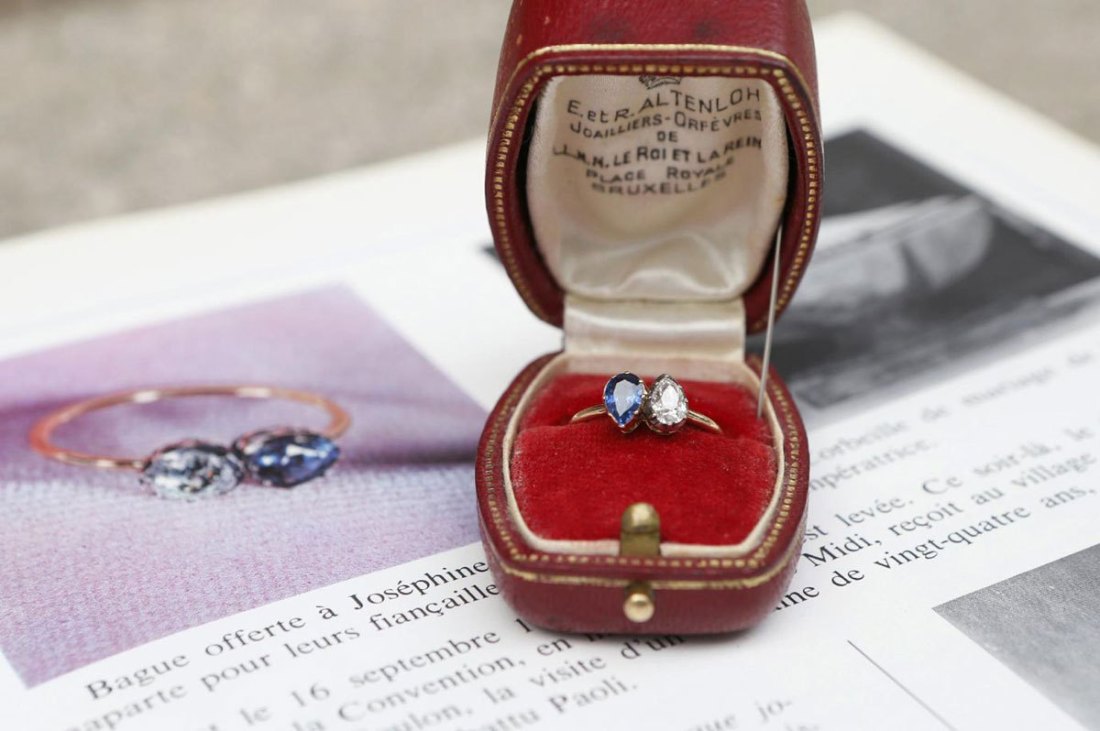
Engagement ring which Napoleon Bonaparte gave to Josephine
The ring decorated with two pear-shaped gems, a blue sapphire and diamond, which face opposite directions came from the collection of Emperor Napoleon III (a nephew of Napoleon Bonaparte) and his wife Eugenie. Napoleon was a revolutionary soldier when he met Josephine de Beauharnais, an older woman with two children and his family fiercely opposed to that relationship. Engaged for a mere two weeks before they married on 9 March, 1796, Napoleon left the country two days later to lead the French army to their victorious invasion of Italy.
Gordon Parks – Black Muslim Protest, 1963 (via)
Stop sending people to kill me! We’ve already captured five of them, one of them with a bomb and another with a rifle…If you don’t stop sending killers, I’ll send a very fast working one to Moscow, and I certainly won’t have to send a second.
The Onion, 1914
Well they aren’t wrong
The victors banner over the Reichstag.
“gentle reminder that cleopatra’s beauty is rumored to have started wars in ancient history” — a post going around Tumblr
Actually Cleopatra was said to have not actually been that beautiful — men said that until she opened her mouth, she was simply average. What made her beautiful according to Plutarch was her personality and intelligence. Her sparkling wit, charming personality, talent with over half a dozen languages, and in-depth knowledge of almost everything was just so impressive that she often became beautiful in their eyes.
So while that post is nice in that it’s trying to say that women are becoming more beautiful and that if you lived in 30 B.C., you could have started wars, I like this version much better.
You may not be traditionally beautiful, but goddamn neither was Cleopatra and she seduced two of the most powerful men in the world.
Her name was Simone Segouin, also known by her war name, Nicole Minet. When this photo was taken on August 19th 1944 she was 18 years old. She had killed two Germans in the Paris fighting two days previously, and also had assisted in capturing 25 German POWs during the fall of Chartres.
Simone Segouin was involved in armed actions against enemy convoys and trains, attacks against enemy detachments, acts of sabotages, etc. The French newspaper Independent Eure-et-Loir on its August 26, 1944 issue described her as “one of the purest fighters of heroic French Resistance who prepared the way for the Liberation”. She was present at the fall of Chartres, on August 23, 1944, and at the Liberation of Paris. She was promoted to lieutenant, and awarded the Croix de guerre. A street in Courville-sur-Eure was named for her.
Eric Bouvet, The Fall of the Berlin Wall, 1989
 darknesstohislight